Eii, NCC, BIS, BICS – Acronym Salad Decoded

Electricity taxes & levies, and their discount schemes, the acronyms and why the most important thing to understand is still your business.

BIS and BICS

For months, we have been resisting abbreviating the British Industrial Competitiveness Scheme as BICS, instead using BIC.  Our main driver in this was to try to limit confusion with the British Industry Supercharger, BIS, which is typically now how we refer to the Energy Intensive Industries Renewable Levy Exemption and the Network Charging Compensation Scheme.

The acronym gods have decided though and the British Industrial Competitiveness Scheme will be BICS!

Compensation vs Exemption

A compensation scheme like the NI Eii scheme or the NCC provides compensation in arrears, typically a year after your business has paid those taxes or levies.  An exemption scheme provides the cost avoidance up front, via your supplier invoicing so that you never pay them in the first place.

Both BICS and BIS provide exemptions, BIS also has a compensation element.

In Northern Ireland, there is not yet an equivalent to BICS or NCC, but the Eii scheme is the Energy Intensive Industries Compensation for the Indirect Costs of Funding the Renewable Obligation Scheme so businesses wait to receive the payments rather than seeing discounted invoicing.

NACE, SIC and HS Codes

Eligibility for all of these schemes is based on what kind of a manufacturer you are.

BIS uses NACE codes

BICS uses SIC and HS codes.

A Nomenclature of Economic Activities, or NACE code is a four-digit code uniquely identifying a specific type of economic activity.  It is a European system to classify what kind of business you are.

A Standard Industrial Classification, or UK SIC code is a five digit code, they are based directly on the nomenclature of NACE codes, excepting the final digit, which was introduced to refine further into different forms of business.

To convert between NACE and SIC, simply remove the separating “.” between the two numbers of the NACE code and add a 0.

HS Codes, or Harmonized System codes are different.  Developed by the World Customs Organisation these categorise the goods produced to enable taxing during global export.  Typically 6 digits, but with the ability to add additional sub-classifications, in the UK these tend to be 10 digits long.  It is the global system for trading and requires much more granular detail on your actual outputs, rather than your activities as a business.

The move to look at outputs not just area of activity should be seen as an indication of future direction for other schemes, and the requirement to update SIC codes which are not reflective of production outputs may open areas of challenge on other scheme eligibility.

We understand the charges and the codes for you so you can focus on what you do best.

Understanding your activities and production data, alongside your GVA is essential when assessing how best to deliver the optimum reduction in your taxes and levies as a manufacturer.  At Ethical Sustainability we work alongside you, understanding your processes and production, your plans and strategies and providing insights on how they may shift your eligibilities over time.

Contact us today to start understanding your eligibility!

5 Weeks to Go – Time Risks for BICS

Just five weeks to go until the first application window closes and access to two years of British Industrial Competitiveness Scheme benefits is lost.

Some key timeline risks you need to know about if you haven’t started yet:

  1. Six Digit Company Authentication Code – Used for filing your accounts with companies house, you should hold this on record but if you don’t you will need to apply for it to be sent to you by post to your registered address – time cost up to 10 working days.
  2. SIC Code Change – If you manufacture eligible products but don’t have an eligible SIC code listed you must add one – time cost up to 3 working days.
  3. Signed Letter from a Registered Officer – Depending on your company structure this may be no time cost at all or a significant one –  time cost around 5 working days.

Your actual timeline remaining could be only 2.5 weeks to gather your evidence!

The Evidence Pack

“Applications must be completed carefully, as there will be no opportunity to amend an application after it has been submitted.  Applications may be rejected where the evidence provided is incomplete, inconsistent, unclear, has been altered, or is insufficient to verify eligibility or the exemption claimed.”
British Industrial Competitiveness Scheme: guidance for applicants – GOV.UK

In our article here we discussed the evidence you need to submit with your application.  Gathering and labelling your production data by HS code is the top bottleneck we are seeing in building the evidence for submission.  This is the basis of any electricity use apportioning where there is a mixture of eligible and ineligible production on site.

It is crucial that you get this application right.  The benefits on the line if you are rejected due to insufficient evidence are significant.


If your application isn’t done yet, what’s holding you up?  Contact us now for support!


The best time to prepare your BIC application was last month!

… The next best time is now!

It’s an old idiom, but perfect in our current situation.  The British Industrial Competitiveness Scheme opened yesterday, and many businesses who are likely eligible were not prepared.  Their applications weren’t ready, and still aren’t. Worse, in many cases, eligible businesses aren’t even aware of the scheme and what they stand to miss out on if they don’t apply in the next eight weeks.

That isn’t their fault – the consultation on legislative changes still hasn’t fed back and communications about the scheme have largely been left to Sustainability Consultancies like ours and Accountants trying to ensure their clients don’t miss out.

You can’t change the past, all we can do is take decisive action as soon as you become aware.  So what do you need to prepare?

Information on your company, including your companies house number (as you must be registered to apply) and your six digit authentication code used for submitting accounts.

Applications are at Site Level, not Business Level.  So if your business is based in Northern Ireland but you have a manufacturing site in England, Scotland or Wales – it can still apply!

For each site:

  • a description of the site, what equipment is there, eligible and non-eligible activities undertaken (Site Layouts and potentially Process Flows can be used as evidence here),
  • a copy of your electricity supply contract,
  • six months of electricity invoices
  • six consecutive months, monthly production data to include your Production Orders Record, Production Logs and Quality Control Records.
  • Your calculations and/or submetering data justifying any split in electricity consumption between eligible and non-eligible production on site.

You can apply even if your SIC code isn’t eligible, as long as you can demonstrate that your electricity is used to produce eligible HS code products!

The above evidence in many cases will already be available in your organisation.  Even if it isn’t you will be able to prepare an application with our support to ensure compliance, but in some cases you may need an on-site survey prior to submission and time is running low for these.

Inaction and delay come with a price in this case – the second best time to act is NOW!

BIC – What’s New?

In two weeks time, applications for the first year of the British Industrial Competitiveness Scheme (BIC) should begin and then, in ten and a half weeks they will close.  So where are we and what are we still waiting for?

The consultation on the required legislation updates to enable BIC to happen closed a week ago, but the outcome has not yet been published.

The proposals would allow Exchequer funding to be channelled through the CfD supplier obligation to prevent implementation of BICS from increasing electricity bills for households and other non-exempt consumers.


“Exchequer funding received by the Low Carbon Contracts Company (LCCC) would reduce the amount that LCCC needs to recover from suppliers to fund CfD generator payments, resulting in a lower Interim Levy Rate (ILR) and lower reserve amounts than would otherwise apply. The Government intends for the first Exchequer payment to reach LCCC in time for it to be reflected in the levy from 1 April 2027, when the BICS exemption is expected to take effect. 

The Government’s minded position is that payments should be made to LCCC each quarter before the ILR is calculated. Further details will be set out by the Department for Business, Innovation, Science and Trade (DBIST) in due course. DBIST will separately publish an Impact Assessment setting out how the implementation of the BICS exemption will not lead to an increase in electricity bills for domestic consumers or non-eligible businesses.”


The changes are relatively minor and simple to the legislation, however they are crucial to the operation of the scheme in the above manner, to protect other companies from footing the bill:

Amendment of the Contracts for Difference (Electricity Supplier Obligations) Regulations 2014

  1. The Contracts for Difference (Electricity Supplier Obligations) Regulations 2014 are amended as follows.

Amendment to regulation 2 (interpretation)

  1. In regulation 2, in the definition of “SoS funds”, omit “(under section 154(2)(b) of the Act)”.

Amendment to regulation 5 (CFD quarterly contribution)

  1. In regulation 5, for the definition of “SoS repayment” substitute— “SoS repayment is the total amount of SoS funds that the CFD counterparty was required to repay during that period;”.

Amendment to regulation 7 (estimated cost, income and electricity supply)

  1. In regulation 7—
    1. in paragraph (1)—
      1. after “sum of” omit “any SoS repayment and”;
      2. after “estimates of” insert “any SoS repayment and”;
    2. in paragraph (2), before sub-paragraph (a) insert— “(za) the terms on which any SoS funds have been or are expected to be provided to the CFD counterparty;”.

Proposed legislative changes to support implementation of the British Industrial Competitiveness Scheme – GOV.UK


We know roughly how the FY2026 equivalent payment will be calculated.  However, we do not yet know when this payment will be made – the consultation and the implementation guidance both state this will be updated as soon as possible to confirm the timeline.

The one-off payment equivalent to FY2026 benefits was confirmed in the consultation on regulatory changes and scheme delivery, and we were told that:

“This payment will be proportionate in value to what businesses would have been entitled to had BICS exemptions been in operation earlier.  To ensure businesses receive support that closely mirrors this, calculations to confirm the value of payments to be received by individual businesses will use: 

  • historical estimated electricity consumption data

  • a government-set average RO, FIT and CM policy cost discount rate

  • the businesses’ banded pro-rating percentage, to ensure that payments reflect eligible electricity use.”


We know how the application process will work, and that 6 years of records for audit must be kept on all matters relevant to the application.

“BIST may undertake proportionate verification activity before and after exemptions are awarded, including both targeted and random checks where appropriate.”

“Businesses must retain all records and supporting evidence relating to their application for at least 6 years and make them available to the Department on request. Records must be sufficient to demonstrate eligibility and substantiate any information provided as part of the application or ongoing exemption.

Failure to maintain or provide adequate records may result in recovery action, withdrawal of support, or other appropriate compliance measures.”

We will keep monitoring the information available as the scheme matures and if you have any questions or want to know more about BIC and how it might benefit your business, please contact us.

Eii NCC vs BIC (British Industrial Competitiveness Scheme)

There is always excitement around a new discount scheme announcement, and you will be hearing about BIC from lots of companies right now.  This guide will give you an overview of what we expect from the scheme compared to the existing Eii with NCC scheme.

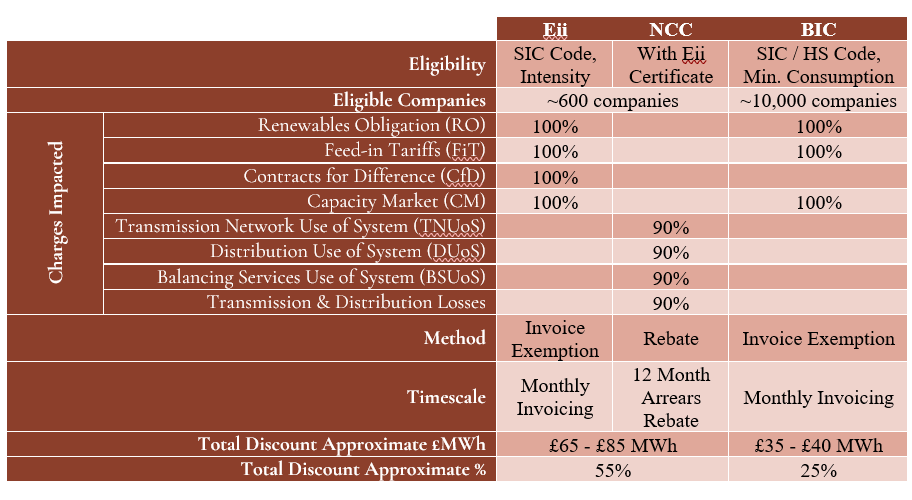
The existing Eii Exemption and British Industry Supercharger (Network Charging Compensation) Scheme is designed for the most intensive electricity consumers only, it includes a company level intensity test to prove 20% of GVA is on reference price electricity costs but provides not only exemption from renewable tariffs but also access to network charging compensation rebates.

The British Industrial Competitiveness Scheme is a new scheme targeting Frontier and Foundational manufacturers, it provides similar tariff exemptions to the Eii exemption scheme, also applied to your supply invoices, however you cannot access the NCC scheme network compensations.  In year one, it will provide an additional year of benefit as a one-off compensation payment via your electricity supplier.

Some key facts on the schemes are below:

As you can see, whilst BIC is an amazing opportunity for manufacturers who are not eligible for Eii and NCC, it is of lower value than the original scheme and eligibility for Eii should always be checked too.

© 2026 Ethical Sustainability | Designed + Built by Studio Artemisia