To date, the focus on Net Zero and reducing emissions has been in pursuit of meeting the legal obligations of the Paris Agreement. Limiting warming to 1.5°C remains the foundation of international climate policy, but we have failed in this objective, we will see global warming above 1.5°C. This report talks about the inevitable overshoot clearly, what impact it might have, and what we now need to mobilise to achieve. Much of the below article is simply quoted directly from the report as a summary, as it needs no further contextualisation. Please do read the original text in it’s entirety if you can: https://www.unep.org/resources/limiting-overshoot-navigating-exceedance
Well below 2°C was set as our global target for good reason. Global warming of a degree and a half is not safe, it already comes with huge implications.
- Some locations might become more or less uninsurable, or even uninhabitable (Vanos et al. 2023; Chen and Lin 2024; Spencer et al. 2024). High-mortality summer seasons are expected to become commonplace without adaptation (Lüthi et al. 2023).
- The effects on agriculture will drive significant productivity losses and threaten the food security and livelihoods of billions of people (FAO 2023a; FAO and WMO 2026)
- Climate-related changes in food availability and diet quality are estimated to increase nutrition-related diseases and the number of undernourished people, affecting at least tens of millions of people, particularly among low-income households in low- and middle-income countries in sub-Saharan Africa, South Asia and Central America (IPCC 2023a)
- Global glacier loss is projected to continue for centuries even if global warming were stabilized at current levels, and will alone lead to 9cm of sea level rise (Zekollari et al. 2025, Rounce et al. 2023)
- Adjustments in the hydrological cycle, atmospheric circulation and major ocean circulations such as the Atlantic Meridional Overturning Circulation (AMOC) are projected to continue for centuries well after emissions have ceased (Lacroix et al. 2024).
- Permafrost carbon losses may be irreversible, even if permafrost areas may partially recover under global warming reversal (Cui, Ji and Chen 2025)
- Irreversible impacts on forest and other ecosystems, such as Amazon forest loss and high-latitude woody encroachment (Munday et al. 2025)
- Increased likelihood of crossing ecological thresholds and tipping points, such as large-scale forest die-back (Meyer and Trisos | UNEP | Limiting Overshoot 2023)
The most stringent emission reduction pathways that were available around the time of the Paris Agreement are no longer feasible. Such pathways required immediate, deep and sustained global GHG emissions reductions to start as early as 2015 or 2020. We now need to face the consequences of our inaction and work hard to mitigate the impacts.
The above should not be interpreted as evidence that action no longer matters. It changes the pathway: from avoiding exceedance altogether to limiting how high and how long temperatures rise above 1.5°C while preserving the possibility of returning below it. Every fraction of a degree and every year above 1.5°C increases exposure to climate hazards and the likelihood of irreversible loss (IPCC 2022a; Schleussner et al. 2024; Reisinger et al. 2025).
Overshoot narrows options and increases risks, costs and trade-offs. It does not eliminate the ability to limit additional harm!
The most effective risk management strategy is to reduce emissions rapidly in the near term and progress towards net zero as early as possible, thereby limiting peak warming and the duration of exceedance. Proactive adaptation is equally essential – not only to reduce harms but also to maintain capacity to sustain mitigation efforts under the increasing pressures associated with overshoot.
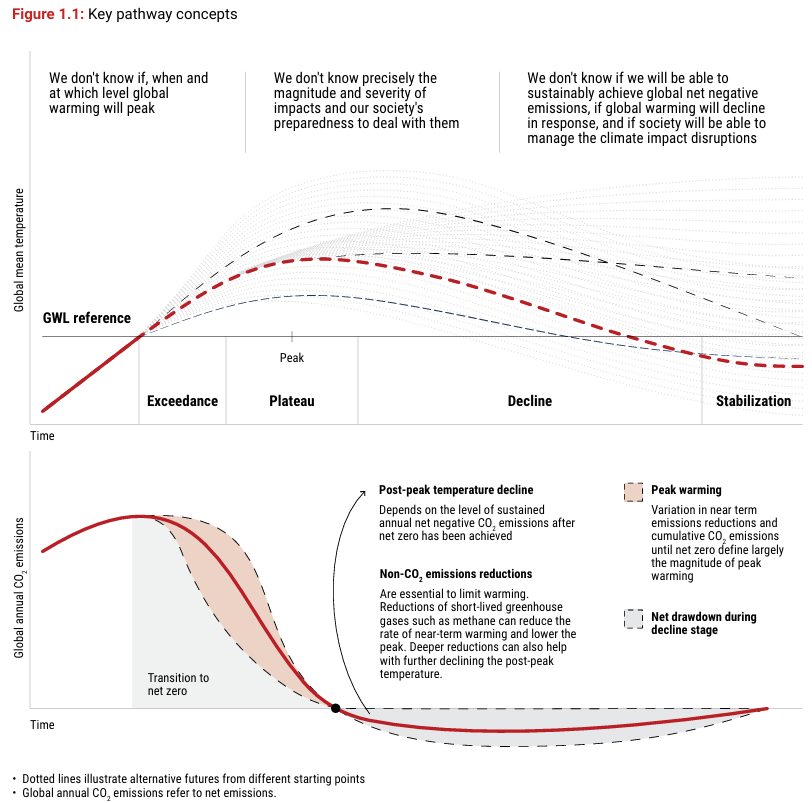
Rapid and sustained mitigation within this decade is both necessary and feasible across all sectors and GHGs to hold warming well below 2°C and as close to 1.5°C as possible by the end of the century. The challenge is to act while recognizing uncertainty, rather than waiting for uncertainty to disappear.
We must reach global net-zero CO₂ emissions in the 2050s, alongside deep reductions in other gases.
We must avoid new high-carbon assets and accelerate retirement or retrofitting of existing high-emission infrastructure. Agriculture and Waste will be key areas for Methane reduction and Carbon Dioxide Removal is crucial but becomes more difficult at higher levels of warming, further emphasising the need to act fast.
Net-Zero is now only a milestone towards Net-Negative
Halting global warming at any level below 2°C already requires reaching at least net-zero CO₂ emissions globally, along with deep reductions of other GHGs, particularly methane (IPCC 2021). Reversing global temperature would rely on mitigation efforts going beyond this, to reach sustained global net-negative CO₂ emissions alongside continued further reductions in residual non-CO₂ GHGs.
Here at Ethical Sustainability we firmly believe that we can reverse our trajectory and that UK manufacturing is a crucial part of the solution. Come talk to us about the risks and benefits your business will be exposed to by 1.5°C warming!