

This article will always be pinned on our articles page, we would encourage you to bookmark it! Our industry is full of acronyms, and our founder detests them. So here, you can find an explanation of every acronym we use day-to-day. We add to this whenever we realise there’s another that we haven’t got listed so it’s a long document but we hope you find it useful!
Utility Procurement
DA: Data Aggregator, after the data collector has validated it, the data is submitted to a data aggregator who profiles it into settlements, resolves any exceptions and submits it to be used to bill the supplier for the energy that consumers have used.
DC: Data Collector, responsible for remotely collecting 48 half-hourly periods of consumption data from each meter, or manually reading where remote connection is not possible. The data collector then validates the data and if they have been unable to obtain actual data creates estimates in line with industry regulations. They then securely submit the data to your registered supplier for billing. The Balancing and Settlement Code mandates 99% actual data for HH meters so any meter issues should be rectified promptly.
KWh, A Kilowatt Hour. This is a unit of power over time, the output of a kilo-watt over an hour period, which roughly equates to 3.6 megajoules. It is the standard unit used in billing for electricity.
MOP: Meter Operator, appointed either directly or via your supplier for each meter. MOP contracts typically run for long durations, at least 5 years and the meter operator is responsible for installing, operating, maintaining, and managing electricity meters. They look after the physical asset.
MPAN, Meter Point Administration Number. A 22 digit reference number used to identify an electricity supply point. It is comprised of 9 digits which detail information about the supply point and a 13 digit unique identifier or ‘core’. See our dedicated article on decoding your MPAN here
MPRN, Meter Point Reference Number. The equivalent of an MPAN for a gas distribution point.
MWh, A Megawatt Hour, 1,000 kwh or 3.6 billion joules. Large consumers may find that professionals in the industry speak in MWh about their volume for ease. It is unlikely that you will see other metric abbreviations but we have included them here for your reference:
| Value | Symbol |
Name |
| 10−6 | μW⋅h | microwatt-hour |
| 10−3 | mW⋅h | milliwatt-hour |
| 100 | W⋅h | watt-hour |
| 103 | kW⋅h | kilowatt-hour |
| 106 | MW⋅h | megawatt-hour |
| 109 | GW⋅h | gigawatt-hour |
| 1012 | TW⋅h | terawatt-hour |
| 1015 | PW⋅h | petawatt-hour |
DNO, District Network Operators. These initially formed out of regional electricity companies’ distribution arms. There are fourteen of these with distinct operational regions as shown on the map below, and the relevant portion of the MPAN can identify the region where the meter is based for those DNO references. DNOs are responsible for allocating MPANs to supply point locations.
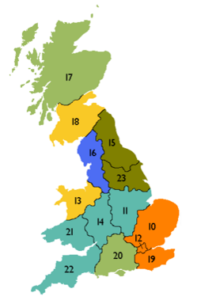
Distribution network operator – Wikipedia
IDNO: Independent Distribution Network Operators, these operate in the same market as DNOs but are not regionally-bound in their operation. Often these are found in areas of more recent additions to the network such as for housing estates. These are also all allocated codes for inclusion in the MPAN however they do not identify the physical location of the supply point.
SSC: Standard Settlement Configuration (SSC). Non half-hourly supplies have four-digit codes called the standard settlement configuration, which specifies the number of registers a meter has, and the times that each register is recording electricity usage, indicating the switching time. This has now been added to the MPAN to capture the data as more meters are designated as HH profiles and smart meters are rolled out.
TPI: Third Party Intermediary. Any company that works between a supplier and their customer, whether they call themselves a TPI, Consultancy or an arms-length government agency, if involved in helping to procure commercial energy contracts the company is a TPI. TPIs are unregulated, though there are live proposals to change this.
Non-Commodities
BIC: The British Industrial Competitiveness Scheme. A brand new scheme for 2027 financial year, with a back payment covering the discounts that would have been secured were the scheme active in 2026. It exempts eligible manufacturers from the costs of Renewables Obligation (RO), Feed-in Tariffs (FIT) and the Capacity Market (CM). based on SIC code alone.
CCA: Climate Change Agreements. These have existed since 2001 and were one of the first schemes to help manufacturers by limiting the costs of utility taxes and levies. Companies agree to reduce energy use and carbon dioxide emissions in exchange for a reduction in CCL taxes on consumed energy.
CHPQA: The Combined Heat and Power Quality Assurance (CHPQA) Programme is designed to give exemption from the main rates of CCL tax and fuel-oil duty amongst other taxes and business rates for those operating their CHPs in an efficient way.
CPS: The Carbon Price Support Mechanism tax on fuels used in electricity generation was introduced in 2013 provide additional support to the emissions trading scheme. The government has announced that CPS will be removed from April 2028
Eii: Energy Intensive Industries. The Eii Exemption scheme provides relief of up to 100% of Renewables Obligation (RO), Feed-in Tariffs (FiT), Contracts for Difference (CfD) and Capacity Market (CM) charges for manufacturers who meet a 20% electrical intensity threshold. Initially, the discount was set at 85% of these charges but as of 2024 eligible businesses are now exempt from 100% of these charges. There is also an Eii Compensation scheme and a NI equivalent scheme which serve similar purposes but with different implementation mechanisms.
NCC: The Network Charging Compensation Scheme (NCC) also known as the Supercharger was added to the Eii scheme to provide additional relief from the charges of maintaining the network for eligible Eii businesses. It provides relief of up to 90% of the costs of Transmission Network Use of System (TNUoS), Distribution Use of System (DUoS), Balancing Services Use of System (BSUoS) and related losses.
UKETS: The UK Emissions Trading Scheme. This is a successor to the EU ETS created for the UK following Brexit. The UK ETS applies to regulated activities which result in greenhouse gas emissions, including combustion of fuels on a site where combustion units with a total rated thermal input exceeding 20MW are operated, it is mandatory. A cap is set on the total amount of certain greenhouse gases that can be emitted by sectors covered by the scheme. Each year, operators covered by the scheme must surrender allowances to cover their emissions. The cap is reduced over time, so that total emissions must fall. Participants receive free allowances and/or buy allowances at auction or on the secondary market
UKETS CPS Compensation Scheme: A scheme designed to compensate electricity intensive industries deemed to be exposed to a significant risk of carbon leakage due to the indirect costs of the UK ETS and the CPS mechanism. A very limited set of companies are eligible, with only14 SIC codes covered and a threshold that indirect carbon costs amount to 5% or more of their gross value added (GVA).
Energy Efficiency
DEC: Display Energy Certificates are a mandatory for buildings occupied by a public authority where, from 9 July 2015, the total useful floor area of the building exceeds 250m2 and which is frequently visited by the public. They rate the energy efficiency of the building from A to G based on the amount of metered energy used by the building over the last 12 months.
EPC: Energy Performance Certificates are intended to provide prospective buyers and tenants of a building with information about the energy performance of the building and practical advice on improving its performance. It is based on the building fabric and services and is required when a building is being sold or rented and remains valid for ten years.
ESOS: Energy Savings Opportunities Scheme. This is mandatory for large undertakings in the UK to assess the energy efficiency of their properties and identify potential improvements on a four yearly cycle.
ESOS APPR: Energy Savings Opportunities Scheme Action Plans and Progress Reports, since Phase 3 any business captured by ESOS is also required to provide an action plan following their submission, and progress reports to show what actions they have taken to improve energy efficiency.
MEES: Minimum Energy Efficiency Requirements apply to domestically rented buildings. Landlords are required to improve properties to at least an E EPC rating unless they have a valid exemption in place. The requirement is to spend up to £3,500 on improvements.
SEC: Significant Energy Consumption, identified assets and activities that comprise 95% of your Total Energy Consumption.
TEC: Total Energy Consumption, for ESOS you must calculate your total energy consumption over a reference period of 12 consecutive months. This includes any energy that is both supplied to and consumed by your organisation. Typically calculated in kWh.
TM44: TM44 is a mandatory five yearly inspection for any air conditioning system that uses a refrigerant as a cooling agent, and has an effective rated output of more than 12kW. It outputs a comprehensive report on the efficiency of the air conditioning system and guidance on how this can be improved and is often a valuable tool in improving energy efficiency.
Carbon
SECR: Streamlined Energy & Carbon Reporting is a mandatory public disclosure of carbon emissions in place since 2019 for companies that meet two of these criteria – 250 employees, £36 Million Turnover, £18 Million Balance Sheet.
TCFD: Task Force on Climate-related Financial Disclosure (TCFD) -aligned disclosure, the UK government’s application of the TCFD recommendations. An annual climate-related financial disclosure that must be made by certain public sector bodies and large companies. It follows a prescriptive format and should provide information for investors on how the viability of that business may be impacted by a changing climate. It is expected that the UK SRS will make TCFD reporting obsolete.
UK SRS: The UK Sustainability Reporting Standards are a new regulatory framework for carbon and climate disclosures which are expected to become mandatory for captured organisations in 2027. They are based on the IFRS standards created by their International Sustainability Standards Board and align with EU disclosure plans.