
There are two elements to consider when defining your electricity contracting plan.
- The form of trading, duration of contract or hedging window and purchasing strategy all impact on the commodity price achieved.
- The supplier chosen and options defined for billing impact your non-commodity charges.
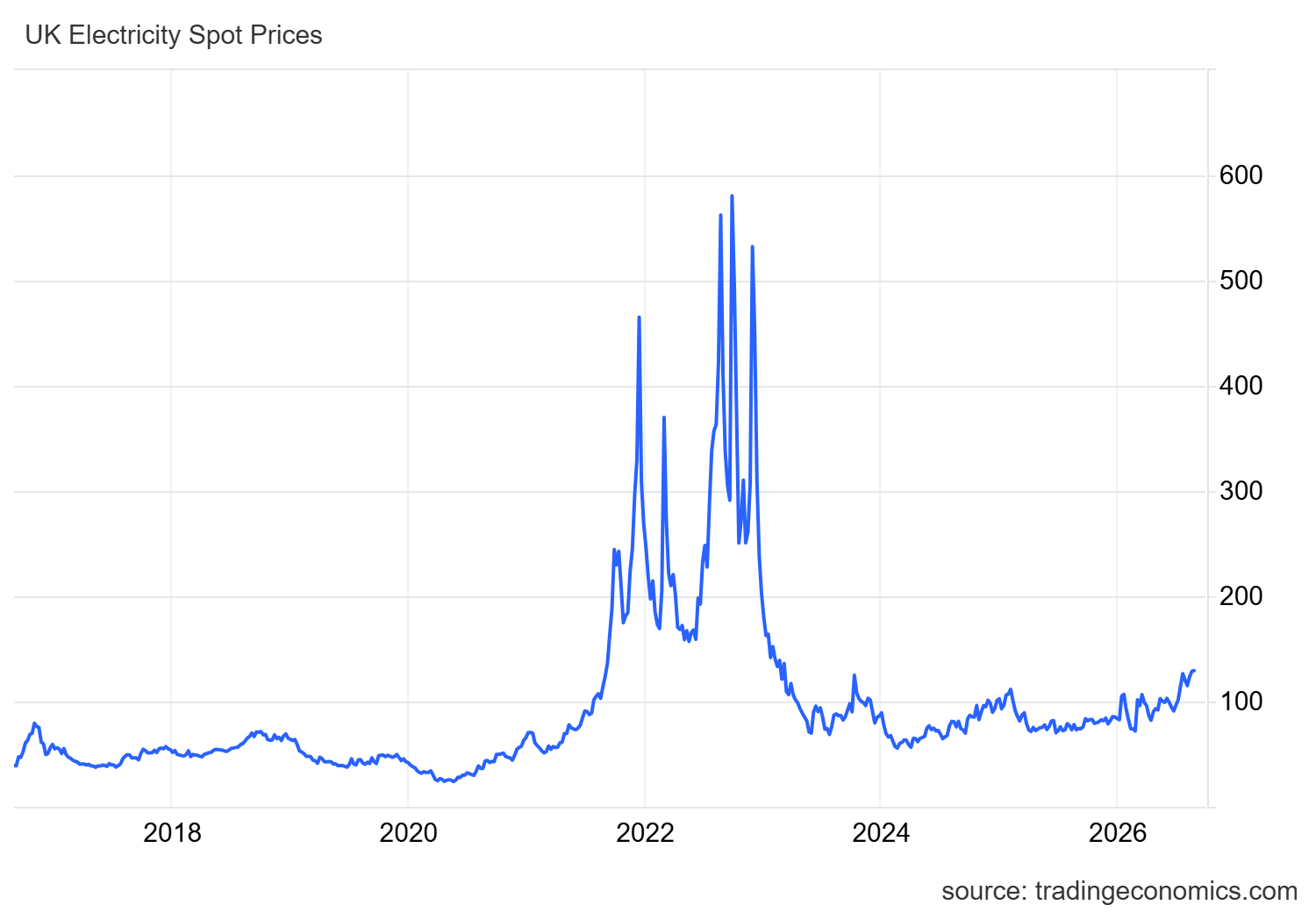
Historically a majority of manufacturers have placed fixed price contracts, for generally a short-term trading window. Since market volatility increased these may not be the most advantageous approach to take. A fixed price supply contract is based on suppliers assessing a suitable price on a single day of the year, then adding risk premium to cover them for potential market movement. Many of these are placed in September for October start dates, which is typically a higher point in the market cycle – it’s very unlikely that a day in September turns out to have been the best day in the year to contract a price.
In the below graph, only 2017 and 2019 would have secured reasonable price if procured in September. Ideally, you would have placed a long-term contract in May 2020, and extended in February 2024. A good consultancy would have been pushing you to extend your contract horizon at those times, regardless of your purchasing method. Contract duration should always be informed by the market and how good current pricing is!
There are a number of ways to go to market for electricity. For small consumers, they are often stuck with fixed price, day priced contracts and can only vary duration. Most manufacturers though, have the option to access the wholesale commodity market. This opens up flexible contracting with a supplier – where you decide when to purchase and how much to purchase. For some that sounds labour-intensive but you can put in place strategies and utilise a TPI to trade on your behalf based on rules you set that reflect your risk profile. Historically many of these flexible contracts used a calendar-based trading system (a set % had to be purchased by a set date). These worked well in a low volatility market, by averaging the cost across the year. Now, the average is not a good price and they have typically been replaced by price and risk based trading strategies.
A footnote here to PPA procurement, which provides typically index-linked fixed pricing for a 10 year period via a complex and costly contracting arrangement.
Moving away from Commodity, the type of Non-Commodity charging is especially important for manufacturers. With taxes and levies making up the majority of your electricity invoice, you shouldn’t just let the supplier dictate how you pay these without considering it. Often when you go to market a supplier will suggest you fix your non-commodity charges. It enables them and you to predict your costs simply with only your usage as a variable, and it removes a risk of rebilling for prior financial years, sounds great right? It can be, if a charge increases it might save you from the impact of that for half a year. But if things change dramatically, suppliers have the right to review these charges anyway, and for manufacturers there are reasons not to fix.
As large consumers you may have access to discounts on these charges, via some of the schemes we administer, and this is significantly harder to validate if your supplier has fixed your charges, or is not fully itemising them on your invoicing. If you go to a supplier to implement Eii exemptions, and you have fixed all your charges, you have zero visibility of what they should be removing. You also have zero way to validate that they have removed a suitable value from your costs. For manufacturers, we recommend a pass-through style contract, and be aware that some suppliers have “pass-through” contracts which are only partially so. You need to ask specifically for an example of the invoicing on the contract you are signing to be sure it is fully pass-through.
If you need support with your electricity contracting, our preference is to act as your advisor rather than an intermediary, but please do reach out to ask for our help!